Best Months for a Rwanda Gorilla Trek (2026): Dry Seasons, Rain and Permits
Two dry seasons, one rainforest that rains all year, and 80 permits a day that vanish fastest in exactly the months everyone wants.
 By Eric Habimana, gorilla trekking guide since 2015
Short answer
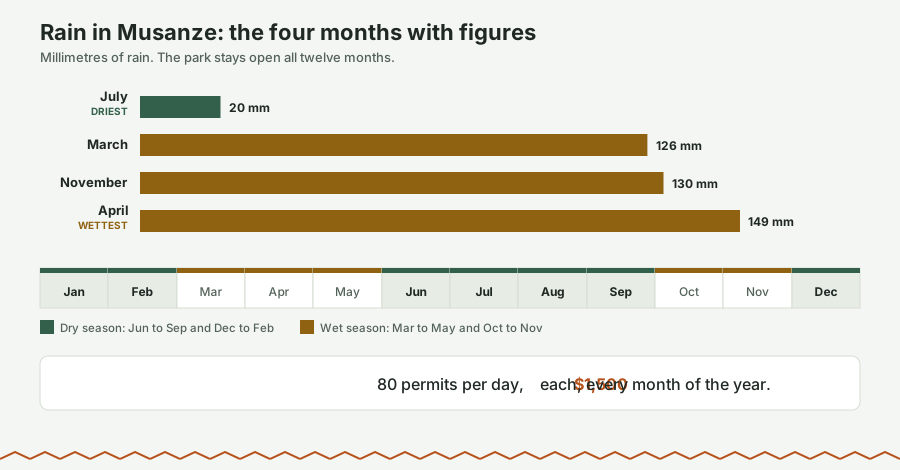
June to September is the driest and most reliable stretch, with July the driest month in Musanze at roughly 20 mm of rain. December to February is the shorter second dry season. Both are peak demand for the 80 permits sold daily at $1,500 each, so April, the wettest month at about 149 mm, is the easiest date to get and the muddiest to walk.
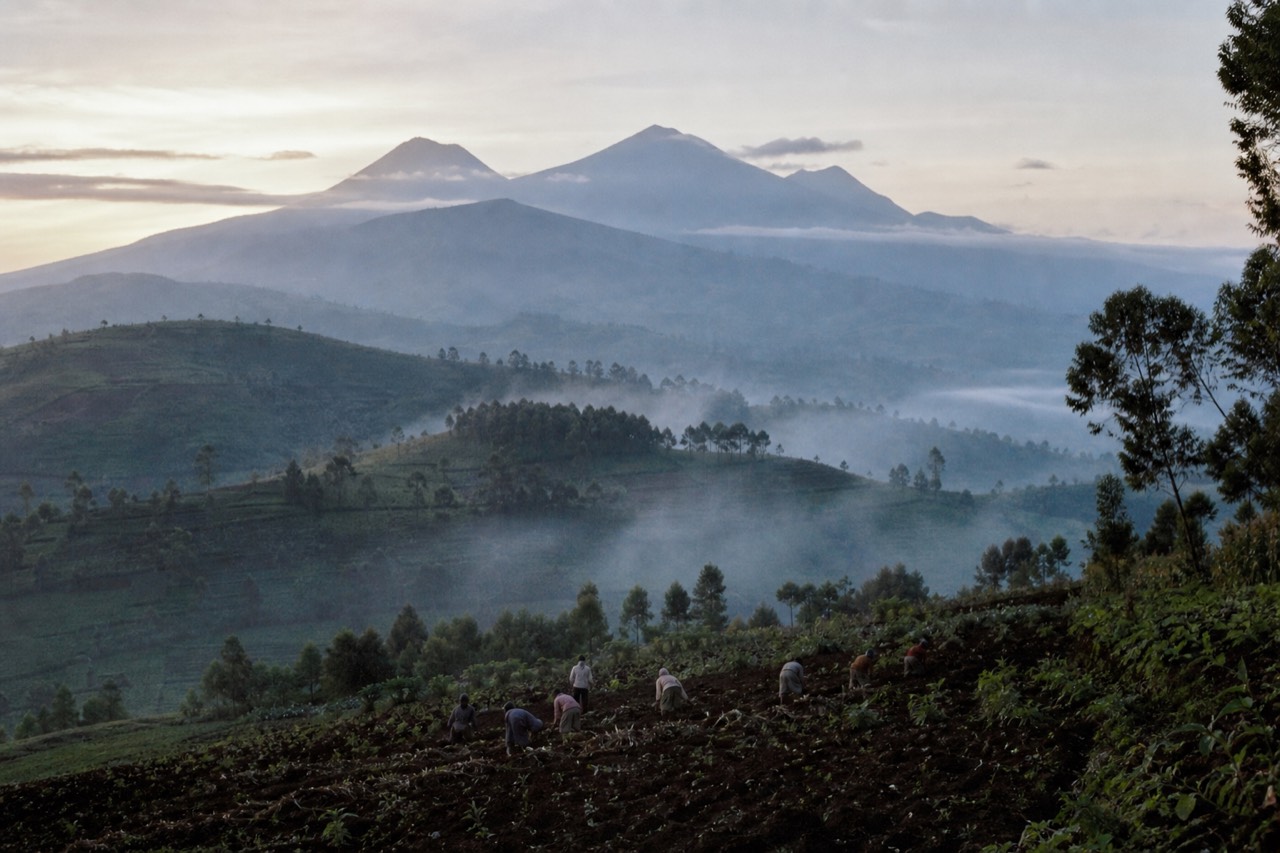
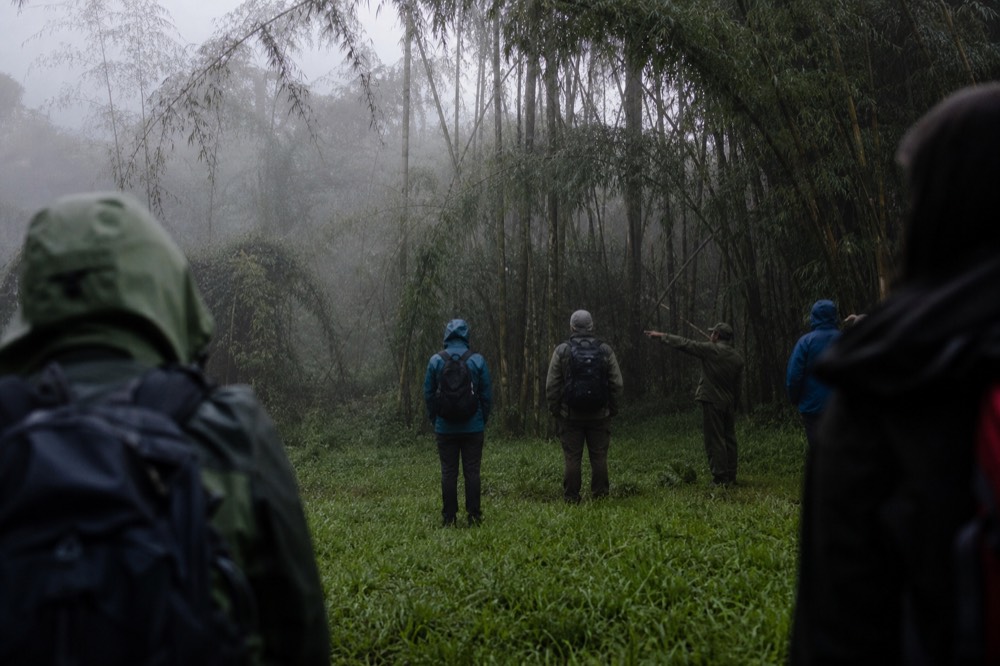
The ground outside the park headquarters at Kinigi is wet at 07:00 in almost every month of the year. Volcanic soil holds water the way a sponge does, and the briefing field shows it. What actually changes between July and April is how far that wetness travels up your legs, how long the walk beyond the buffalo wall takes, and how many other people wanted the permit sitting in your booking confirmation.
Rwanda's tourism authorities name two dry seasons: June to September, and December to February. That is the honest headline and it holds up. The longer answer is that Volcanoes National Park is montane rainforest between 2,500 and 4,000 m, where rain falls in every single month, so the real question is not wet or dry. It is which trade you would rather make.
What is the best month for gorilla trekking?
June through September is the driest and most dependable window, and July is the driest month of all in Musanze at roughly 20 mm of average rainfall. December to February is the second dry season. Both are peak demand for the 80 permits released each day, so the best months for walking conditions are the hardest months to book.
That tension is the whole story of timing a trek here. The Rwanda Development Board sells a fixed 80 permits per day, built from 10 fully habituated gorilla families with a maximum of 8 visitors each, at $1,500 per person for foreign non-residents. Demand is not fixed. It concentrates hard into the dry months, and the supply does not flex to meet it.
So a July trek buys you firmer ground, shorter average walking times and photographs that are not shot through drizzle. It also puts you in the longest queue of the year for a permit that is sold first-come, first-served. An April trek reverses both halves of that trade. The mud is genuinely worse, the average is around 149 mm of rain across the month, and the hillsides above Kinigi turn the colour of a snooker table. The permit, meanwhile, is far more likely to still be there when you go looking.
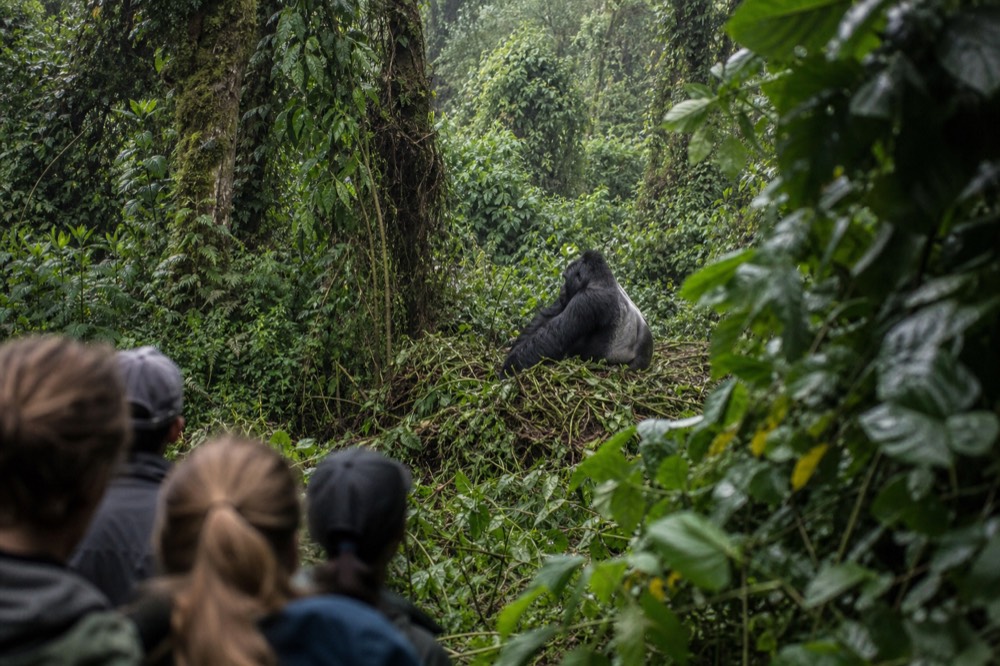
Neither month changes what happens when you find the family. The hour with them is one hour in every season, the 7 m distance rule holds in every season, and flash photography is banned in every season.
The month-by-month scorecard
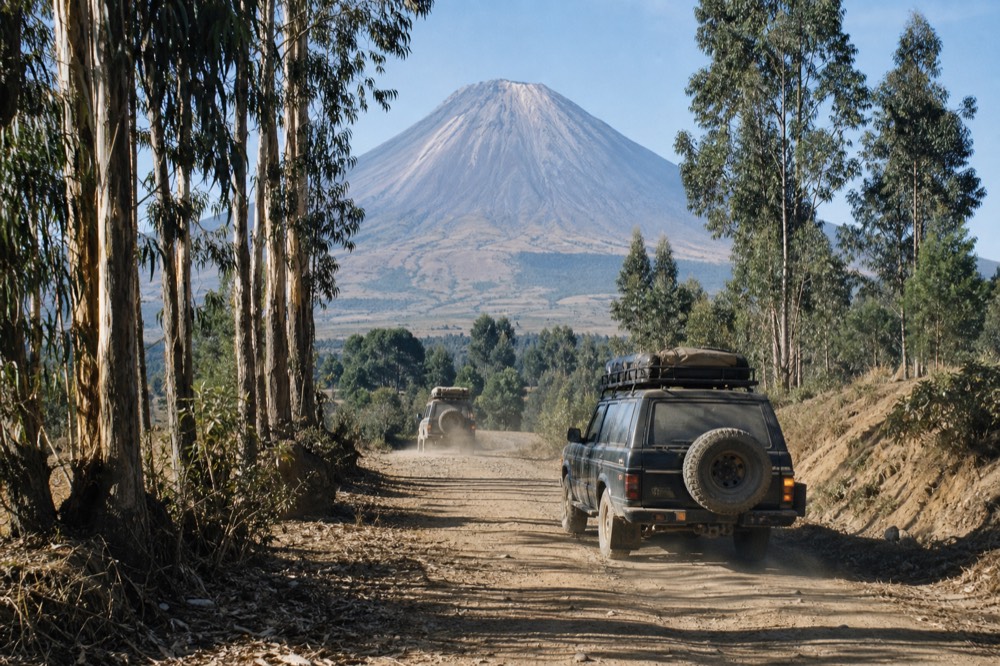
Every month at Volcanoes National Park is trekkable and treks run daily year-round. The scorecard below splits the calendar by the officially named dry seasons, then adds what each month tends to mean underfoot and how hard the permits are to secure. July and August are the safest bet for conditions. March, April and November are the safest bet for availability.
| Month | Season | Underfoot | Permit pressure | Verdict |
|---|---|---|---|---|
| January | Dry (short) | Firm, occasional afternoon shower | High | Excellent, book early |
| February | Dry (short) | Firm, warming, dusty tracks near Kinigi | High | Excellent, the quieter half of the short dry |
| March | Wet | Softening fast, sticky clay | Moderate | Good value, expect real mud |
| April | Wet (peak) | Deep mud, streaming trails | Lowest of the year | Cheapest availability, hardest walking |
| May | Wet, easing | Still soft, drying by late month | Moderate | Late May is an underrated window |
| June | Dry | Drying out, best-improving month | Rising fast | Strong all-round choice |
| July | Dry (driest) | Firmest ground of the year | Highest | Best conditions, worst queue |
| August | Dry | Firm, cool mornings, dusty midday | Highest | Peak of peak season |
| September | Dry | Firm early, softening late month | High | Excellent, slightly easier than August |
| October | Wet begins | Soft again, showers most afternoons | Moderate | Shoulder date worth taking |
| November | Wet | Heavy, slick volcanic soil | Low | Green, quiet, muddy |
| December | Dry (short) | Firming from mid-month | Rising into holidays | Good, but holiday dates go early |
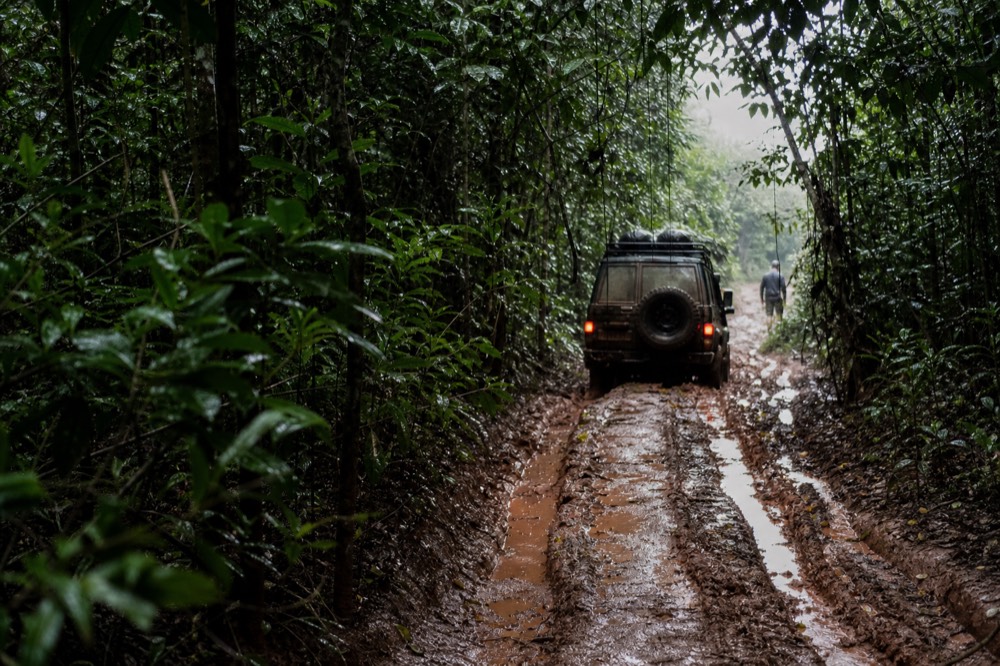
Read that grid as pressure rather than as promise. Weather at 2,500 m does what it likes on any given morning, and a dry-season trek can still finish with rain on the descent. What the calendar reliably predicts is the volume of it, not the presence of it.
How much rain actually falls on Musanze?
Musanze, the town below the park, averages about 149 mm of rain in April, its wettest month, and roughly 20 mm in July, its driest. March sits near 126 mm and November near 130 mm. That is a sevenfold swing between the extremes of the calendar, which is why the same trail can feel like two different sports.
Those are the four months with figures worth quoting, and they frame the year neatly: two rainy peaks, one long dry spell built around July and August, and a shorter dry patch across the turn of the year. The full year-round breakdown for the town sits in the Musanze climate record if you want to see the shape of it.
One caution about applying town figures to the park. Kinigi sits higher than Musanze, and the trailheads higher still, so the forest generally catches more weather than the valley does. Treat 20 mm in July as a signal that the month is dry, not as a promise that your particular morning will be.
What does the rain actually change on the trail?
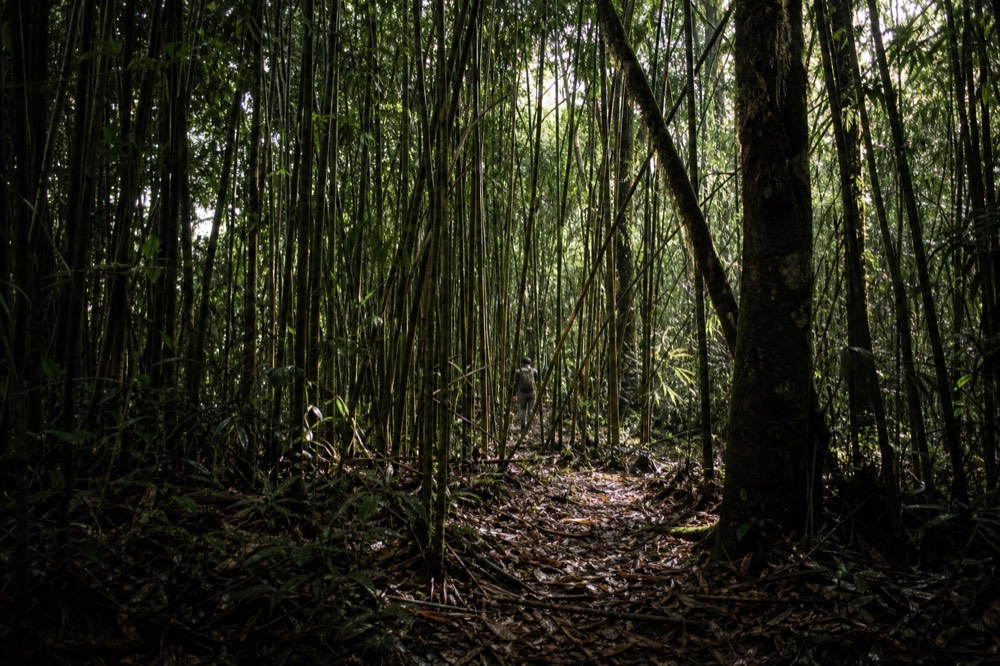
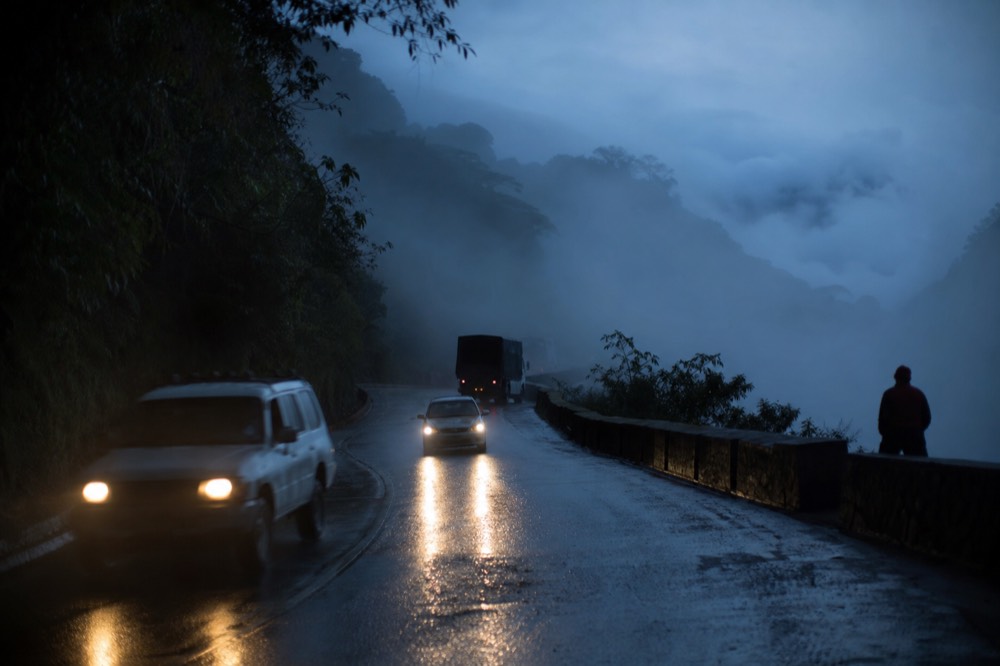
Rain lengthens the walk and steepens the effort. Hiking time to a family already ranges from about 30 minutes to 4 to 6 hours depending on where the gorillas moved overnight, and wet volcanic soil pushes you toward the long end of that range. It does not change the hour you get with them, the 7 m rule or the no-flash rule.
The mud here is not the tidy stuff of an English footpath. Volcanic soil turns to a heavy grease that grabs the sole of a boot and holds it, so each step costs more, and descents become the part where people fall. Trekking poles matter more in the wet than in the dry, and so do gloves, because the reflex when you slip is to grab whatever is beside you, and what is beside you is frequently stinging nettle.
Rain also flattens the light. Photography in the forest is already dim under a closed canopy, and the no-flash rule means you cannot fix that. A wet morning costs you shutter speed at exactly the moment a juvenile decides to move. That is a real trade-off for anyone whose main reason for going is the pictures.
What does not shift is the shape of the day. Briefing at 07:00, the drive to a trailhead, the walk, one hour with the family, then back. Full days run roughly 4 to 8 hours from briefing to return in any season. Our honest read on how hard the climb gets covers what that means for a body that is not used to altitude, and the wet-season packing list is where the gloves and gaiters argument gets settled properly.
How does the season change your chances of getting a permit?
Permits are sold by the Rwanda Development Board on a first-come, first-served basis through its own portal, at $1,500 per person for foreign non-residents, capped at 80 per day. The board does not publish sell-out dates. What is published is that June to September and December to February are peak season, which is where the queue forms.
That distinction matters. Anyone telling you that July permits sell out exactly nine months ahead is guessing, because the official channel simply does not release that data. What you can act on is the structure: fixed daily supply, no waitlist mechanism, a booking that requires passport details and payment, and a demand curve that piles into two windows a year.
The practical consequence is that your date and your permit should be decided together, not in sequence. Travellers who book flights first and go looking for a permit afterwards are the ones who end up moving their trip. Check the permit portal for the live position before you commit to anything else, and read our full walkthrough of how permits are sold if you want the mechanics in detail.
| If you want to trek in | Permit pressure | Lock this first | If the date is gone |
|---|---|---|---|
| July or August | Highest of the year | The permit, before flights | Slide to late September |
| June or September | High, rising through June | Permit and lodging together | Take the last week of May |
| December to February | High around the holidays | The permit, holidays first | Early February is quieter |
| March, October, November | Moderate to low | Flights, then the permit | Rarely needed |
| April or May | Lowest of the year | Whatever suits you | Rarely needed |
Once the permit is yours, the ground logistics are the easy half. A day trek from Kigali handles the 90-minute drive to Musanze, the onward run to Kinigi and the 07:00 briefing timing for you. The most-reviewed of them sits at 5.0 across 81 reviews, from $360 for the day with meals and hotel pickup, with the $1,500 permit bought separately, and you can check which dates it still has open before you buy the permit itself.
The honest case for the wet season
Trekking in March, April or November costs you dry boots and buys you three things: a far better chance of the permit you actually want, a park with fewer people on it, and a forest at its greenest. The mud is real and it is the reason the price of entry, in effort, goes up.
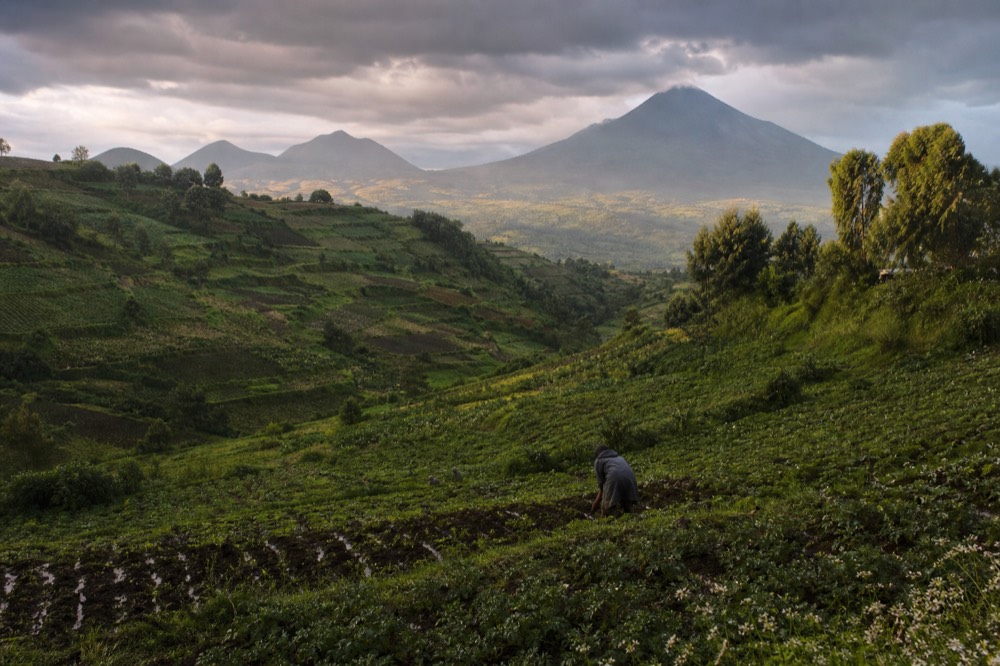
Green season photographs do not look like dry season photographs. The bamboo is lush rather than dusty, the hillsides below Kinigi are planted and vivid, and the cloud that hangs on the volcanoes gives the ridgelines a depth that a clear July morning flattens out. If your camera roll matters more than your boots, that is a genuine argument.
There is a comfort argument too, though it points both ways. Wet-season days are not colder in any dramatic sense, but wet clothing at 2,800 m feels colder than dry clothing at the same temperature, which is why a rain shell earns its place in the daypack in every month, July included.
The honest counterweight: a long wet trek is hard work. If you are already unsure about the physical side, the wet season is the wrong time to find out, and hiring a porter stops being optional and starts being sensible. Porters cost around $10 to $20 for the trek, carry your pack and pull you up the greasy sections, and in April that is the best twenty dollars in the country.
| Factor | Dry season (Jun-Sep, Dec-Feb) | Wet season (Mar-May, Oct-Nov) |
|---|---|---|
| Trail surface | Firm, grippy, faster | Deep mud, slower, slippery descents |
| Typical walking effort | Lower end of the 30 min to 6 hr range | Pushed toward the long end |
| Permit availability | Tight, first-come at 80 a day | Much easier to secure |
| Photography light | Brighter, cleaner sightlines | Flat, dim, greener backdrops |
| Scenery | Dustier tracks, clearer volcano views | Vivid green, cloud-wrapped peaks |
| Porter value | Useful | Close to essential |
| People on the mountain | Peak numbers | Noticeably fewer |
How cold does it get at 2,500 to 4,000 m?
Daytime temperatures around the 2,400 m park edge usually sit between 15 and 22°C, and drop about 6.5°C for every 1,000 m of climb. At trekking altitudes of 2,500 to 4,000 m that often means 7 to 13°C, with nights in the 6 to 13°C band and frost possible at the highest points.
Those numbers explain a packing mistake people make every week of the year. Rwanda sits on the equator, so travellers arrive dressed for the equator, then stand in a field at Kinigi at 07:00 in a t-shirt while a ranger explains the rules. The briefing is the coldest part of the day and the hike is the warmest, and the gap between them is bigger than the gap between January and July.
| Moment of the day | Where you are | Typical feel | What you want on |
|---|---|---|---|
| Pre-dawn pickup in Kigali | ~1,500 m, in a vehicle | Mild, dark | Travel clothes, warm layer in the bag |
| 07:00 briefing at Kinigi | ~2,400 m, standing still | 15-22°C but wind-chilled and damp | Fleece over the trekking shirt |
| Climbing to the family | 2,500-4,000 m, working hard | 7-13°C ambient, but you are hot | Base layer only, shell in the pack |
| The hour with the gorillas | Wherever they are, standing still | Cools fast once you stop | Fleece and shell back on |
| The descent | Dropping altitude, often wet | Warm and muddy | Shell if it is raining, gloves regardless |
The rule that follows is simple: layers beat any single warm garment, and the shell goes in the pack even in the driest week of July. A dry month is not a rainless month at this altitude.
What is the best month to visit Rwanda?
For a trip built around the gorillas, June to September wins on conditions and December to February wins on shoulder-season balance. For a trip that also takes in Kigali, Lake Kivu or a second primate trek, the same dry windows apply, because the roads and the viewpoints reward the same weather the trails do.
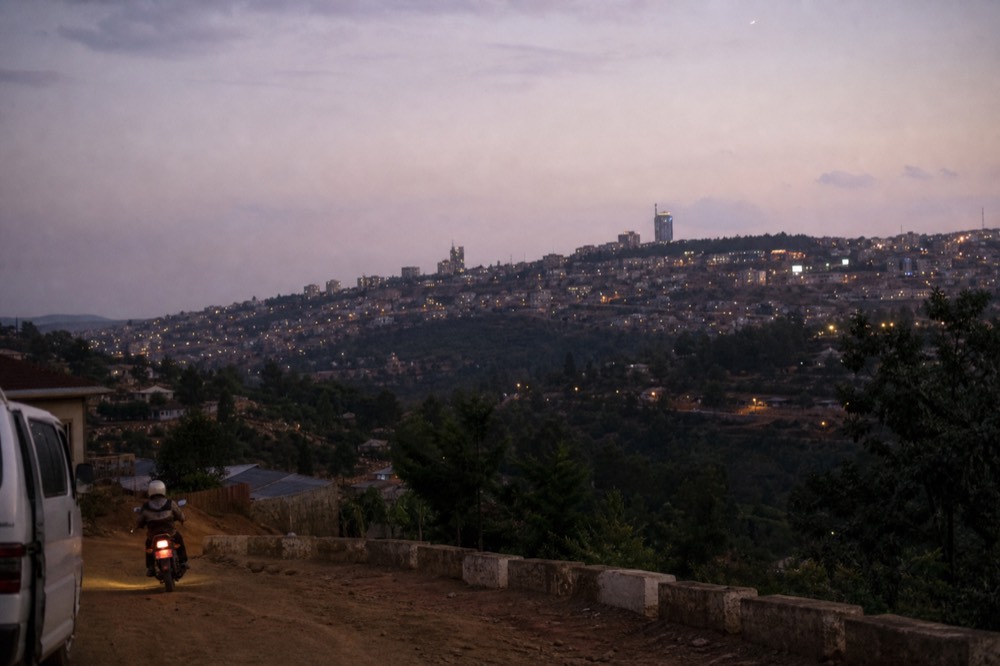
The country is small and the drive times are short, which is why the timing decision usually collapses back into the trekking decision. Kigali to Musanze is about 90 minutes on good tarmac, then a shorter run to Kinigi. A dry-season visitor can pair the gorillas with golden monkeys in the same park without adding a long transfer, and our guide to the park itself sets out how the sectors fit together.
Two practical points that sit outside the weather. Every nationality can get a visa on arrival, at $50 single entry or $70 multiple entry, with the East Africa Tourist Visa at $100 if Uganda or Kenya are also on the itinerary. And travel advice for Rwanda is not uniform: the United States has held a Level 3 "Reconsider Travel" advisory since May 2026, with a Level 4 zone within 10 km of the DRC border that includes part of Musanze District, the district Volcanoes National Park sits in. Treks have continued to run daily. We handle that properly in the safety guide rather than glossing it here.
If you want to see the whole spread of dates and formats side by side, the full trek lineup shows which departures run year-round and which are seasonal in practice.
What does not change, whatever month you book?
The park's rules are season-proof. One hour with the family, 7 m of distance, maximum 8 visitors per family, 80 permits a day at $1,500, a 07:00 briefing at Kinigi, a minimum age of 15 with no exceptions, and no trekking at all if you turn up visibly sick.
That last one deserves more weight than it usually gets. Rangers can and do turn away anyone with a cold or flu, because a human respiratory infection can move into a gorilla family with serious consequences. It applies in January exactly as it applies in August, and it is not negotiable at the briefing field.
| Fixed rule | The number | Why it exists |
|---|---|---|
| Time with the family | 1 hour, maximum | Limits stress and disease exposure |
| Distance | 7 m (about 22 ft) | Reduces transmission risk both ways |
| Group size | 8 visitors per family | Keeps the encounter small |
| Daily permits | 80, from 10 habituated families | Hard cap on total visitor pressure |
| Permit price | $1,500 per foreign non-resident | Funds park operations and community share |
| Minimum age | 15 years, no exceptions | Health and behaviour risk |
| Briefing | 07:00 at Kinigi park HQ | Family assignment happens here |
| Photography | Permitted, never with flash | Flash startles the animals |
| Illness | No trekking while visibly sick | Shared disease susceptibility |
The etiquette side of those rules gets its own treatment in our piece on why guides tell you not to smile at a gorilla, which is a stranger rule than it sounds and a real one.
Which trek suits which season?
Every trek on this site runs year-round, so season affects comfort and permit odds rather than availability of the tour itself. The split that matters is whether the $1,500 permit is inside the price. Day treks from Kigali leave it out. The all-in and multi-day options build it in and are non-refundable as a result.
In the wet months, the argument for a longer or all-inclusive format gets stronger, because a package that owns the permit, the transfers and the lodging removes the scenario where the permit falls through after everything else is paid for. In the dry months, when you have already secured a permit yourself, a lean day trek is usually the better value.
| Trek | From | Permit in price? | Shape of the day | Season note |
|---|---|---|---|---|
| 1-Day Gorilla Trek from Kigali | $360 | No, permit is $1,500 extra | 12 hours, hotel pickup, meals in | Year-round, dry dates go first |
| Gorilla Tracking Day Trip from Kigali | $260 | No, permit is $1,500 extra | Full day, 4:30am pickup, lunch in | Leanest ground cost in any month |
| Gorilla Trek + Dian Fossey or Gorilla Guardians | $300 | No, permit is $1,500 extra | 6 to 10 hours, private 4x4 | Add-on works best on drier days |
| 1-Day All-In Trek, Permit Included | $3,350 | Yes, permit inside | 13 hours, Kinigi briefing | Removes permit risk in peak months |
| 3-Day Gorilla Safari, Permit Included | $3,746 | Yes, permit inside | 3 days, lodges and meals | Buffers weather across more days |
| Gorilla or Golden Monkey Trek | $345 | Gorilla no, golden monkey yes | 1 day, either primate | Golden monkeys are the wet-day fallback |
For the arithmetic behind those numbers, including what a permit-included price is really buying, see the full cost breakdown, and for the hour-by-hour version of a single day, the day trek from Kigali walkthrough. If you would rather have the permit handled inside one booking, you can see what the all-in day currently costs on the operator's page.
Questions people ask about timing
What is the best month for gorilla trekking?
July, on conditions alone. It is the driest month in Musanze at roughly 20 mm of average rain, which means the firmest trails and the shortest walking times inside the usual 30 minute to 6 hour range. It is also the most competitive month for the 80 permits sold daily at $1,500, so book the permit before anything else.
What is the best month to visit Rwanda?
June to September for the long dry season, or December to February for the shorter one. Both suit gorilla trekking, road travel and the volcano views equally well. April is the wettest month at about 149 mm and the quietest on the mountain, which makes it the best month for anyone who cares more about securing a permit than about staying clean.
Can you go gorilla trekking in the rainy season?
Yes. Treks run every day of the year and the park does not close for weather. Rain makes the volcanic soil slippery and pushes walking times toward the longer end, so waterproof boots, gaiters, gloves and a rain shell matter more. The hour with the gorillas and the 7 m distance rule are unchanged.
How far in advance should I book a Rwanda gorilla permit?
As early as your dates are firm, especially for July, August or the December holidays. The Rwanda Development Board sells 80 permits a day on a first-come, first-served basis and does not publish sell-out timelines, so there is no official lead time to quote. Secure the permit first, then build flights and ground arrangements around it.
Does the permit price change by season?
The published rate for foreign non-residents is $1,500 per person year-round on the Rwanda Development Board portal. Season affects how easily you get a date, not what you pay. Ground costs vary by operator instead: day treks from Kigali start around $260 to $360 without the permit, while all-in formats that include it start at $3,350.
Is it colder in the dry season?
Not dramatically. Temperatures near the park edge at about 2,400 m usually run 15 to 22°C by day, falling roughly 6.5°C per 1,000 m of climb, so 7 to 13°C is normal at trekking altitude in any month. Nights sit around 6 to 13°C. What changes with the season is wetness, and wet clothing at altitude feels much colder than dry clothing.